Language of Flowers
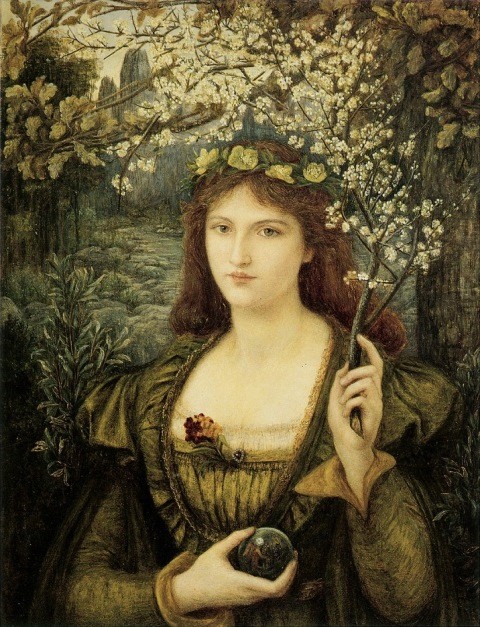
Marie Spartalli Stillman, Madonna Pietra Degli Scrovigni, 1884
Flower, as the embodiment of beauty, has always occupied a special place in the history of human society. For thousands of years flowers have been an integral part of our communication, enriching it with new colours and meanings. Therefore, the language of flowers is as old as the mankind itself. It is a reflection of our history and culture.
In the 19th century, Europe was almost literally mad about flowers. They were everywhere – in the house, in the garden, on the clothes, held in hands... Numerous dictionaries about the meaning of flowers were published, enabling to decipher flower bouquets presented. Every periodical of that time was full of advices how to make flower arrangements. In fact, the level of mastering flower arrangements was a clear indicator of a young girlʼs abilities in general. Women were busy studying botany and floriography – a newly emerged science about the meaning of plants. Queen Victoria of Great Britain was so much enchanted by the language of flowers that she became its devoted ambassador not only in England, but in far-flung colonies as well.
Love for flowers overstepped the bounds of garden
Victorian flower fever finds its roots in the 18th century Ottoman Empire (present time Turkey) and pre-revolutionary France. In the first half of the century, the whole court in Constantinople was so much obsessed by tulips that the period between 1718 and 1730 was called Tulip era.

Pierre-Louis Victor Viger du Vigneau, "The Rose of Malmaison", 1867
|
On the other hand, in France Enlightment intellectuals provided a firm ground for it, arousing interest in botany alongside other sciences. From the beginning of the 19th century, in France and elsewhere flower gardens were highly favored, and attempts were made to produce as many blooms as possible. Thus, the love of Napoleonʼs wife Josephine for flowers and roses specifically, is easy to understand. It inspired the empress to create the famous gardens of Malmaison, where over 250 species of roses were cultivated, brought from the most distant corners of the world. |
Love for flowers overstepped the bound of gardens – indoors, they also played a significant role. Flowers were grown in pots, cut flowers arranged in grand bouquets, in the evening, noble ladies tried to imitate them making artificial flowers and embroidering. Flower images adorned picture frames and other interior details like wallpapers, tapestry, porcelain...
In the 19th century, people literally wore flowers. Men wore flowers not only at weddings and other important celebrations, businessmen and fashionable men wore them regularly, pinned to the buttonhole of their coat. Unlike today, men used to receive flowers on different occasions as well.
Flower bouquets: secret language of the refinedIn the 19th century, people literally wore flowers. Men wore flowers not only at weddings and other important celebrations, businessmen and fashionable men wore them regularly, pinned to the buttonhole of their coat. Unlike today, men used to receive flowers on different occasions as well.
| And what about women? They loved to wear flowers in their hair, often in an elaborate spray from the florist. By the way, floristry occurred in the 19th century, alongside with the growing demand to arrange flowers for many different occasions. Not so often flowers would adorn casual dresses, something not to be said of hats, which women loved to decorate with flowers, real or artificial. Ballroom dresses were heavily ornamented with flowers – a well-dressed belle could have single blooms or garlands of them pinned to richly draped skirt and overskirt, around her neck, on her waist and wrists. She could also carry a bouquet in her hands. |

Wladyslaw Czachorski, "In front of the Mirror", detail, 1888
|

Sophie Liénard, "Queen Victoria at the theatre", 1837
|
Flower bouquets (often called tussies-mussies or nosegays) are a very special part of the 19th century story. They consisted of fragrant flowers or herbs, meant to be held in hands. They were wrapped in real lace doilies and tied with a satin ribbon, or put into a special holder. Such holders were frequently real works of art. So, wrapping of flowers into serrated paper or cellophane is just a sad reminiscence of splendid bouquets from the times gone by... Women would carry them into balls, theatres, concerts, and would sometimes take them for a promenade – a fragrant bouquet, with the nose down in it, would help to pass some stinking place with proper grace. Flower bouquets were among the most popular gifts in the 19th century. They provided a possibility to express feelings, thoughts and attitudes which could not be spoken directly. Even in the same social class, it was impolite or even rude to discuss certain topics openly, especially those concerning relationships and heart affairs. |
| Direct communication was by far much more restricted than it is today, confined into rigid rules of proper etiquette. Of course, flirtations and secret meetings did take place, but, differently from the present day, higher classes of society handled it with considerable subtlety, refinement and discretion. Flower bouquets were used to convey secret messages, and careful consideration was given to be certain the flowers sent the message intended. Everything had symbolic meaning: the way the bouquet was given, the way it was received and held. For example, a person could say "yes" by offering a flower with the right hand – and "no" with the left hand. If a lady held the flowers at heart level, it meant happiness and acceptance, and opposite feelings if held pointed down. The way the ribbon was tied also had meaning. Tied to the left, the flower symbolism referred to the giver. Tied to the right, the flowers talked about the givee. The language of flowers was not for the unobservant! |
 Bouquet holder, 19th century, France |
 Edmund Blair Leighton, "Lady in a Garden", end of 19th – beginning of 20th century |
Not only for positive feelings
The language of flowers was not without contradictions. In different cultures, plants could have different or even opposite meanings. For example, basil in Italy could mean best wishes, hatred in Greece and holiness in India. So, many different meanings could be attributed to one flower or herb. On the other hand, many different plants shared the same meaning, like ivy, pine and yellow rose all symbolized friendship.
During Victorian times many handbooks were produced to guide the giver and givee as to the meanings. However, among other sources, the author’s imagination also played a significant role, therefore, by far not all of the books agreed on meanings. Since travelling was getting more and more afordable, in many parts of the world new plants were discovered, many of them having no established meanings. The same plant, depending on the dictionary used, could have a very different, even opposite meaning. Just imagine how many oddities could occur! So it was really important that persons involved would be literally on the same page when it came to the interpretations.
It might seem odd today, but Victorians used bouquets to denote not only sympathy, friendship or love, but also negative attitude or even insult that was too rude to articulate in high society. For example, lily generally means purity of heart, magnificence and beauty. However, yellow lily meant pure and simple hatred. This could be intensified with a yellow lily which has some positive meanings, such as gratitude, but mixed with orange the message of falseness would be more than evident. In certain cases, perhaps where somebody would want to mock an opponent's lack of luck with the opposite sex, the amaranthus flower, representing loneliness, could be presented; and, to state the message even plainer, nuts, which mean stupidity, could be involved in a tussie-mussie. In fact, any insult by giving flowers could be done ironically. For example, false sympathy for heartache by presenting yarrow, which is generally considered to be a cure for matters of the heart.
Letʼs make flowers talk
Although the language of flowers has lost its flamboyance and richness, our collective consciousness has preserved some of it till the present day. After refreshing our knowledge, we can make a "talking" tussie-mussie for our dear ones and friends. An arrangement made by loving hands, adorned with real lace and satin ribbon (if meant for a woman) will be very personal and unique. With a suitable choice of flowers, numerous thoughts and feelings can be conveyed, without having to come right out and say them in words – which we might avoid due to the lack of time or courage, or maybe just because itʼs too hard... Silent flowers say them for us – in a much more tender and subtle way. And, in order to be "in the same page" while interpreting the message, a small card explaining the meanings of flowers can be attached.
 George Dunlop Leslie, "The Language of Flowers", 1882 |
Below you will find just a tiny dictionary of meanings, selected for the flowers usually grown or well known in our geographical location. Let it be our first step to learn the secret language of flowers...
Lina Krasnovaitė, 2015
The language of flowers: dictionary*
A
ASTER - Symbol of Love, Daintiness, Talisman of Love
AZALEA - Take Care, Temperance, Fragile, Passion, Chinese Symbols of Womanhood
C
CACTUS - Endurance, My Heart Burns with Love
CAMELLIA - Admiration, Perfection, Good Luck Gift for a Man, Gratitude
CARNATION (GENERAL) - Fascination, Devoted Love
CARNATION (PINK) - I'll never forget you, Women's Love
CARNATION (RED) - My heart aches for you, Admiration
CARNATION (DEEP RED) - Alas! for my poor heart
CARNATION (PURPLE) - Capriciousness
CARNATION (SOLID COLOR) - Yes
CARNATION (STRIPED) - No, Refusal, Sorry I can't be with you, Wish I could be with you
CARNATION (WHITE) - Sweet & Lovely, Innocence, Pure Love, Woman's Good Luck Gift
CARNATION (YELLOW) - Disappointment, Rejection No! - Carnation, Yellow
CATTAIL - Peace, Prosperity
CHAMOMILE/GOLDEN MARGUERITE/ANTHEMIS - Energy in Action
CHRYSANTHEMUM (GENERAL) - Abundance & Wealth,
Cheerfulness, You're a wonderful friend
CHRYSANTHEMUM (RED) – Love
CHRYSANTHEMUM (WHITE) - Truth
CHRYSANTHEMUM (YELLOW) - Slighted Love
CLEMATIS - Artifice (ingenuity)
CYCLAMEN - Resignation and Good-Bye
D
DAFFODIL - Regard, Unrequited Love, Sunshine, Respect, The sun shines when I'm with you
DAFFODIL (YELLOW ) - Chivalry
DAHLIA - Dignity and Elegance, Forever Thine
DAISY - Innocence, Loyal Love, I'll Never tell, Purity, Beauty
DELPHINIUM - Big-Hearted, Fun
DILL - Lust
EVERLASTING - Never Ceasing Memory
F
FERN - Magic, Fascination, Confidence, Shelter
FLAX - Domestic Symbol
FORGET ME NOT - True Love, Memories
FOXGLOVE/FAIRY THIMBLES/DEAD MEN'S BELLS - Stateliness, Youth
FREESIA - Innocence, Trust
FUCHSIA (SCARLET) - Confiding Love, Taste
G
GERBERA - Innocence
GLADIOLI - Generosity, I'm sincere, Flower of the gladiators
H
HEATHER (LAVENDER) - Admiration, Solitude
HEATHER (WHITE) - Protection, Wishes will come true
HYACINTH (GENERAL) - Games & Sports, Rashness, Flower dedicated to Apollo
HYACINTH (BLUE) - Consistency
HYACINTH (PURPLE) - Sorry, Please forgive me, Sorrow
HYACINTH (RED OR PINK) - Playful Joy
HYACINTH (WHITE) - Unobtrusive Loveliness, I'll pray for you
HYACINTH (YELLOW) - Jealousy
I
IRIS - Faith, Wisdom, Promise in Love, Hope, Wisdom & Valor
J
JASMINE (WHITE) - Amiability
L
LAVENDER - Love, Devotion,
LILAC (GENERAL) - Beauty, Pride
LILAC (PURPLE) - First emotions of love
LILAC (WHITE) - Youthful Innocence
LILY (GENERAL) - Majesty & Honor, Purity of Heart
LILY (ORANGE) - Hatred, Dislike
LILY (WHITE) - Virginity, Purity, Majesty, It's Heavenly to be with You, Youth
LILY (YELLOW) - I'm Walking On Air, False, Gay, Gratitude
LILY (CALLA) - Beauty
LILY (DAY) - Coquetry, Chinese Emblem For Mother
LILY (EUCHARIS) - Maiden Charms
LILY (TIGER) - Wealth, Pride, Prosperity
LILY OF THE VALLEY - Sweetness, Tears Of The Virgin Mary, Happiness, Humility
LOVE IN A MIST - You Puzzle Me
LOTUS - Estranged love, Forgetful of the Past
LUPINE – Imagination
M
MAGNOLIA - Nobility, Perseverance, Nobility
MAGNOLIA (CHINESE) - Love of Nature
MARIGOLD (COMMON) - Pretty Love, Sacred, Affection, Caress, Sorrow
MARJORAM - Joy, Happiness
MIMOSA - Secret Love
MINT - Virtue
MISTLETOE - Kiss me, Affection, Difficulties, Sacred plant of India,
N
NASTURTIUM - Conquest, Victory In Battle
NUTS - Stupidity
O
OAK LEAVES - Bravery
OLIVE BRANCH - Peace
ORANGE BLOSSOM - Innocence, Eternal Love, Marriage, Fruitfulness
ORCHID - Love, Beauty, Refinement, Chinese Symbol for Many Children, Thoughtfulness
P
PALM LEAVES - Victory & Success
PARSLEY - Useful Knowledge
PEONY – Bashfulness, Happy marriage, Prosperity
PEONY (RED) – Devotion
PEONY (PINK) - Shame
PETUNIA - Your Presence Soothes Me
PHLOX - Our souls are united, Unanimity
PINE - Hope, Pity
POPPY (GENERAL) - Eternal Sleep, Oblivion, Imagination
POPPY (RED) - Pleasure
PRIMROSE - I Can't Live Without You, Woman
R
RHODODENDRON - Danger, Beware, I am Dangerous
ROSE (BRIDAL) - Happiness
ROSE (BURGANDY) - Unconscious Beauty
ROSE (CORAL) - Desire
ROSE (DAMASK) - Freshness, Persian Ambassador of Love
ROSE (DARK CRIMSON) - Mourning
ROSE (DOG) - Pleasure & Pain
ROSE (GREEN) - I am from Mars
ROSE (LEAF) - You may Hope
ROSE (LAVENDER) - Enchantment
ROSE (ORANGE) - Fascination
ROSE (PINK) - Perfect Happiness, Secret Love, Grace & Sweetness, Indecision
ROSE (DARK PINK) - Thankfulness
ROSE (PALE PINK) - Grace, Joy
ROSE (PEACH) - Immortality, Modesty
ROSE (RED) - Love, I love you, Respect, Beauty
ROSE (DEEP RED) - Bashful, Shame
ROSE (TEA) - I'll Remember - Always
ROSE (WHITE) - Innocence, Purity, Humility, I am Worthy of You, Secrecy, Silence
ROSE (WHITE & RED TOGETHER) - Unity, Flower Emblem of England
ROSE (WHITE-DRIED) - Death is Preferable to Loss of Virtue
ROSE (YELLOW) - Joy, Jealousy, Friendship (one yellow rose with 11 red ones means love & passion)
ROSEBUD - Beauty & Youth, A Heart Innocent of Love
ROSEBUD (RED) - Pure & Lovely
ROSEBUD (WHITE) - Girlhood, Heart Ignorant of Love
ROSEBUD (MOSS) - Confessions of Love
ROSES (Bouquet of full bloom) - Gratitude
ROSES (Single full bloom) - I truly love you, Simplicity.
ROSE (MUSK CLUSTER) - Charming
S
SAGE - Wisdom, Great Respect, Speedwell Female Fidelity
SNOWDROP - Hope, Consolation
SUNFLOWER (TALL) - False riches, Pride
T
TULIP (GENERAL) - Perfect Lover, Fame, Flower Emblem of Holland
TULIP (RED) -Believe me, Declaration of Love
TULIP (VARIEGATED) - Beautiful eyes
TULIP (YELLOW) - There's Sunshine In Your Smile
V
VERBENA - Pray for me, Sensibility
VIOLET - Modesty, Virtue, Affection
To the set Language of Flowers
Sources
1. Seaton, B. The Language of Flowers: a history, The University Press of Virginia, 1995
2. Geraldine Adamich Laufer, Victorian Tussie Mussie [interactive]. Retrieved from: http://www.motherearthliving.com/garden-projects/tussie-mussie.aspx?PageId=1 (watched on May 12th, 2015)
3. Wikipedia.org [interactive]. Retrieved from: http://en.wikipedia.org/wiki/Language_of_flowers (watched on May 12th, 2015)
4. Victorianbazaar.com [interactive]. Retrieved from: http://www.victorianbazaar.com/meanings.html (watched on May 12th, 2015)
5. h2g2.com [interactive]. Retrieved from: http://h2g2.com/edited_entry/A5268035 (watched on May 13th, 2015)
6. Sue Williams, Tussie-mussies: "Talking Bouquets", [interactive]. Retrieved from: http://www.emmitsburg.net/gardens/articles/adams/2002/tussie_mussies.htm (watched on May 13th, 2015)
7. Proflowers.com [interactive]. Retrieved from: http://www.proflowers.com/blog/floriography-language-flowers-victorian-era (watched on May 11th, 2015)
* A Dictionary fragment taken from Victorianbazaar.com
